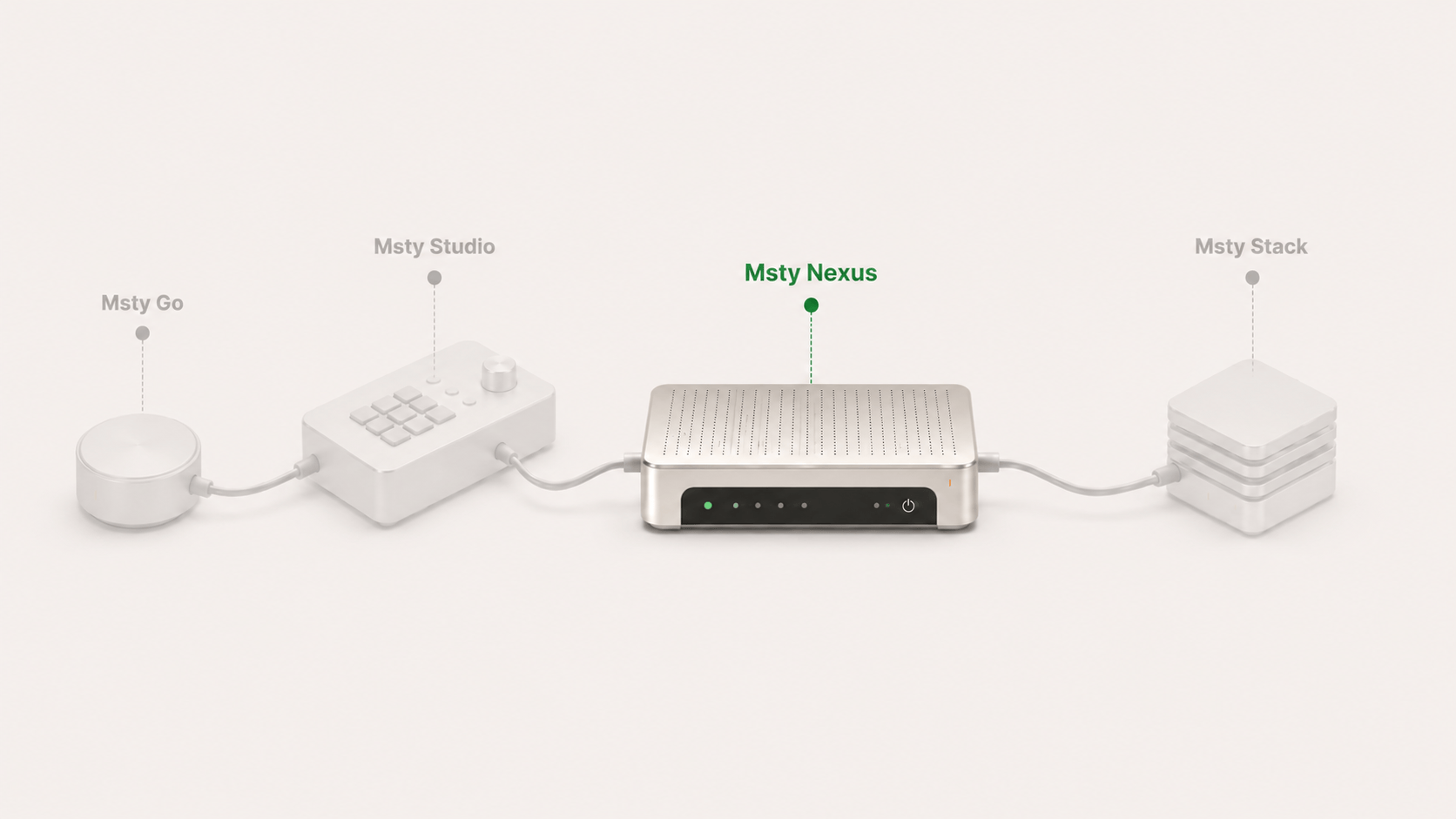
Msty Nexus

One local control center for your AI stack.

Msty Nexus brings local runtimes, provider models, presets, aliases, and secure gateway access into one app so Studio, Claw, scripts, and compatible clients can use the same stack.

Read Announcement
Local gatewayProvider keys stay in NexusExplicit LAN access
Msty Nexus overview screenshot

One catalog

Browse local runtimes and hosted provider models in one list. Filter, hide, pin, and alias the models your apps should use.

One gateway

Expose local OpenAI-style and Anthropic-style gateway surfaces that Studio, Claw, scripts, and compatible clients can share.

One key vault

Keep provider credentials inside Nexus and issue scoped local tokens to the apps that need access.

One approval flow

Review app name, callback, scope, and verification details before granting client access to your local stack.

A tour of the app

Four surfaces. One quiet console.

Nexus is designed to remove duplicate model setup, scattered credentials, and one-off runtime configuration from your AI workflow.

Providers

Provider control without the spreadsheet.

Add hosted providers, sync models, hide providers temporarily, and keep credentials behind the local Nexus boundary.

Msty Nexus providers screenshot

Models

Every model in one catalog.

List Ollama models, llama.cpp builds, MLX checkpoints, Anthropic, OpenAI, OpenRouter, and compatible APIs together.

Msty Nexus models screenshot

Presets

Reusable presets, not copy-pasted prompts.

Bundle model settings, parameters, and routing preferences into presets that connected apps can reference by name.

Msty Nexus presets screenshot

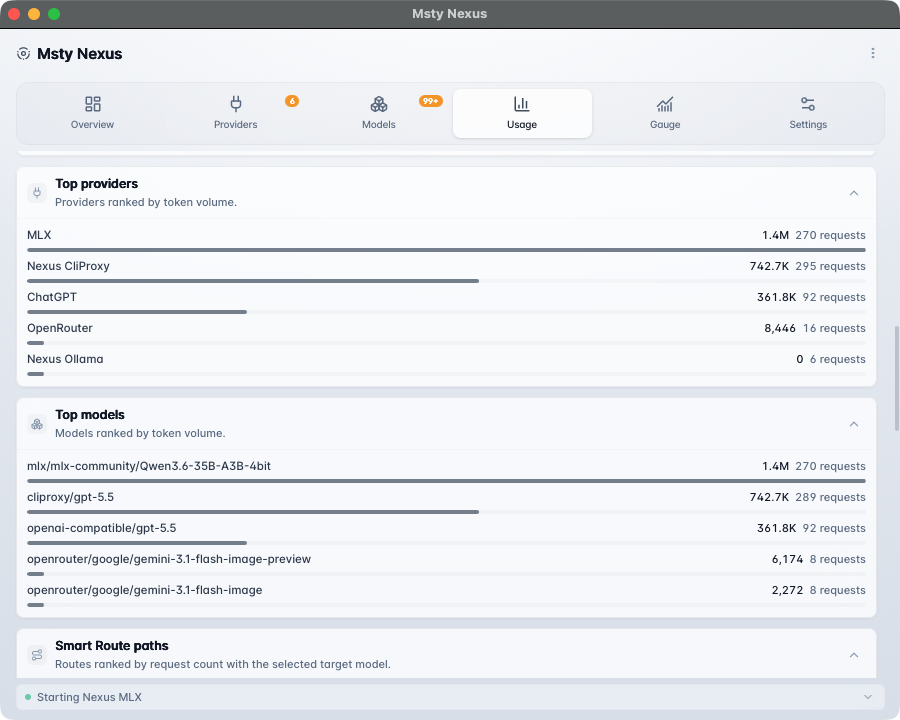
Usage Analytics

See token usage across your stack.

Track provider-reported token totals, request counts, failures, and usage trends by provider, model, and client token from one local console.

Msty Nexus usage analytics screenshot

Credentials & approval

Provider keys stay in Nexus.

Enter a provider credential once. Studio, Claw, scripts, and shell tools authenticate against Nexus with local tokens instead of upstream provider keys.

  • Write-only credential intake. Keys can be set or rotated, but not read back from the app surface.
  • Local Nexus access tokens. Create scoped tokens for apps and scripts, then revoke them from one place.
  • Per-app approval flow. Review the app name, callback URL, scope, and verification code before granting access.
  • Explicit network exposure. LAN access, CORS, and bind-address settings are deliberate choices, not defaults.

The gateway

One endpoint your apps can trust.

Nexus resolves the model or preset, routes each request to the right local runtime or upstream provider, applies the credential, and streams back the response.

Client apps

Msty Studio

local token · chat, models

Msty Claw

local token · agents

Custom script

base URL · Nexus token

Nexus Gateway

POST /v1/chat/completions

POST /v1/responses

POST /v1/messages

GET  /v1/models

GET  /nexus/services

GET  /nexus/presets

OpenAI + AnthropicToken Auth

Upstream

Ollama

local runtime

llama.cpp

local runtime

Anthropic / OpenAI

provider APIs

Local runtimes

Local AI without the babysitting.

Nexus knows how to install, version-pin, start, stop, and watch the runtimes that power local inference.

Ollama

Install, pull, run, and expose mainstream local models through a shared catalog.

llama.cpp

Bring your own GGUFs and manage raw inference services with clearer defaults.

MLX

Use Apple silicon native runtime support where Nexus can manage model records and service state.

Network access

Control what can connect.

Msty Nexus network access settings screenshot

What can talk to it

OpenAI-style. Anthropic-style. One local gateway.

Connect first-party Msty apps, SDK-based tools, shell workflows, or your own scripts when they support configurable API endpoints and local tokens.

01

Msty Studio

02

Msty Claw

03

OpenAI SDK

04

Anthropic SDK

05

curl / shell

06

Custom scripts

Questions

Asked & answered.

Is Nexus a hosted service?

No. Nexus is software you run on your own machine or a server you control. The gateway it exposes is a local endpoint that apps and scripts on the same machine, or on your LAN if you choose, can use.

Where do provider API keys go?

Provider credentials stay in Nexus. Client apps authenticate with local Nexus tokens instead of receiving the upstream provider keys.

Is Nexus open source?

Much of Nexus will be open source so teams can inspect, run, and extend the local gateway with confidence. Some Teams and Enterprise features will remain commercial.

Does this mean nothing leaves my machine?

Not if you use a cloud provider. Cloud-provider calls still go to that provider. Nexus controls routing and credential use from your local runtime.

Which apps can connect?

Msty Studio and Msty Claw are first-party targets. Other clients can connect when they support OpenAI-style or Anthropic-style API configuration.

What about LAN access?

LAN access is off by default. You turn it on explicitly and configure CORS and bind-address behavior from one place.

Get Nexus

One quiet app for the messy middle.

Manage local services, providers, models, presets, and app access from one place.

Read Announcement