
Ai4 2026 brought together some of the biggest names and most ambitious ideas in artificial intelligence. For us here at Msty AI, it was an opportunity to do more than talk about what is next. It was a chance to show it in action.
Before diving into the technology, we recommend watching Adam’s journey to Ai4 2026. It captures the road to Las Vegas, the energy around the event, and a behind-the-scenes look at what Msty brought to the show, including Mac Studios on the move, connected and ready for real-world AI workloads.
But the real story at Ai4 was what happened at the booth where we had a live showcase of Msty Stack and Msty Nexus, two products designed around a simple but important belief that AI should be powerful, flexible, and under your control.
Bringing Local AI to the Ai4 Conversation
One thing stood out at Ai4 2026. While much of the AI conversation continues to center on hosted models and cloud-first platforms, Msty AI focused heavily on the value of local AI - local to your organization using device and on-premises inference.
Local AI matters because not every organization can, or should, send sensitive data to external providers by default. Schools, clinics, small practices, internal teams, research groups, and enterprises all have situations where privacy, control, cost, latency, or compliance considerations make local AI especially compelling.
Msty’s position is not that every task must, or even should, run locally. Instead, our message is more practical. Teams should be able to use the right model for the right job, whether that means a local model running in their own environment or a hosted frontier model for tasks that require it.
That philosophy came through clearly in our two main Ai4 showcases: Msty Stack and Msty Nexus.
Msty Stack: A Central Knowledge Store for Teams and Organizations
Msty Stack was highlighted as a way for organizations to make their internal knowledge more usable with AI.
At a high level, Msty Stack acts as a central store for company, team, or organizational knowledge containing the information users want models to understand and reference when producing useful answers. Instead of relying only on a model’s general training or forcing users to manually paste context into every conversation, Stack is built around making relevant knowledge available to AI workflows in a more structured and dependable way.
For teams, this can support a wide range of use cases:
- Internal documentation assistance
- Company knowledge search
- Support and operations workflows
- Research and analysis
- Policy, process, and training material access
- Team-specific AI assistants grounded in internal context
Better context leads to better answers. When AI can reference the right organizational knowledge, responses become more relevant, more complete, and more useful.
For companies exploring AI adoption, this is often one of the biggest gaps. The model may be capable, but if it does not have access to the right internal information, users still end up doing the hard work of finding, copying, formatting, and explaining context. Msty Stack is positioned to help close that gap.
Msty Nexus: Clustering, Load Balancing, and Smarter AI Infrastructure
While Msty Stack showed how organizations can bring knowledge to their AI workflows, Msty Nexus drew attention by showing how local AI infrastructure can become more powerful and flexible.
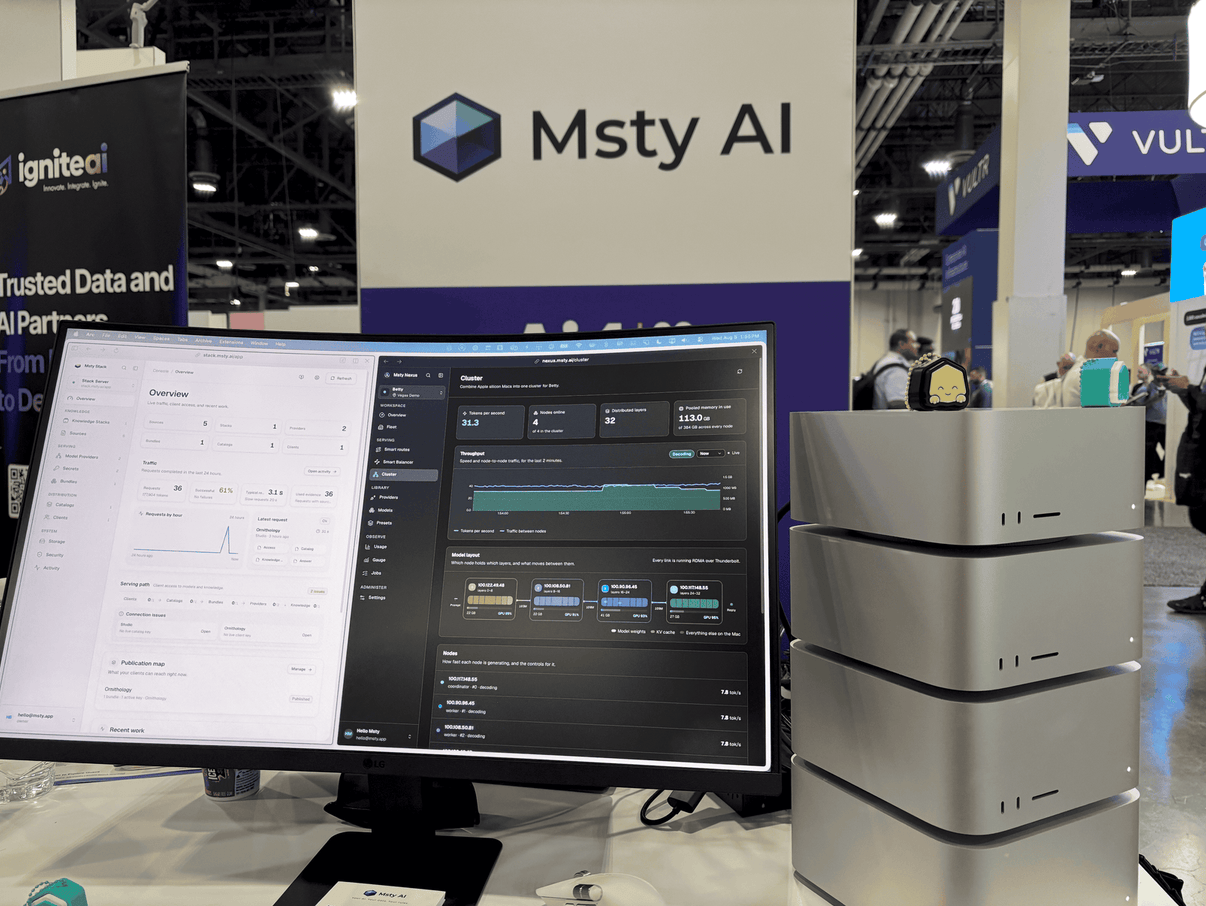
At Ai4 2026, we showcased four Mac Studios clustered together using Msty Nexus. This setup demonstrated clustering and load balancing across multiple machines, with live activity visualized as requests moved between nodes.
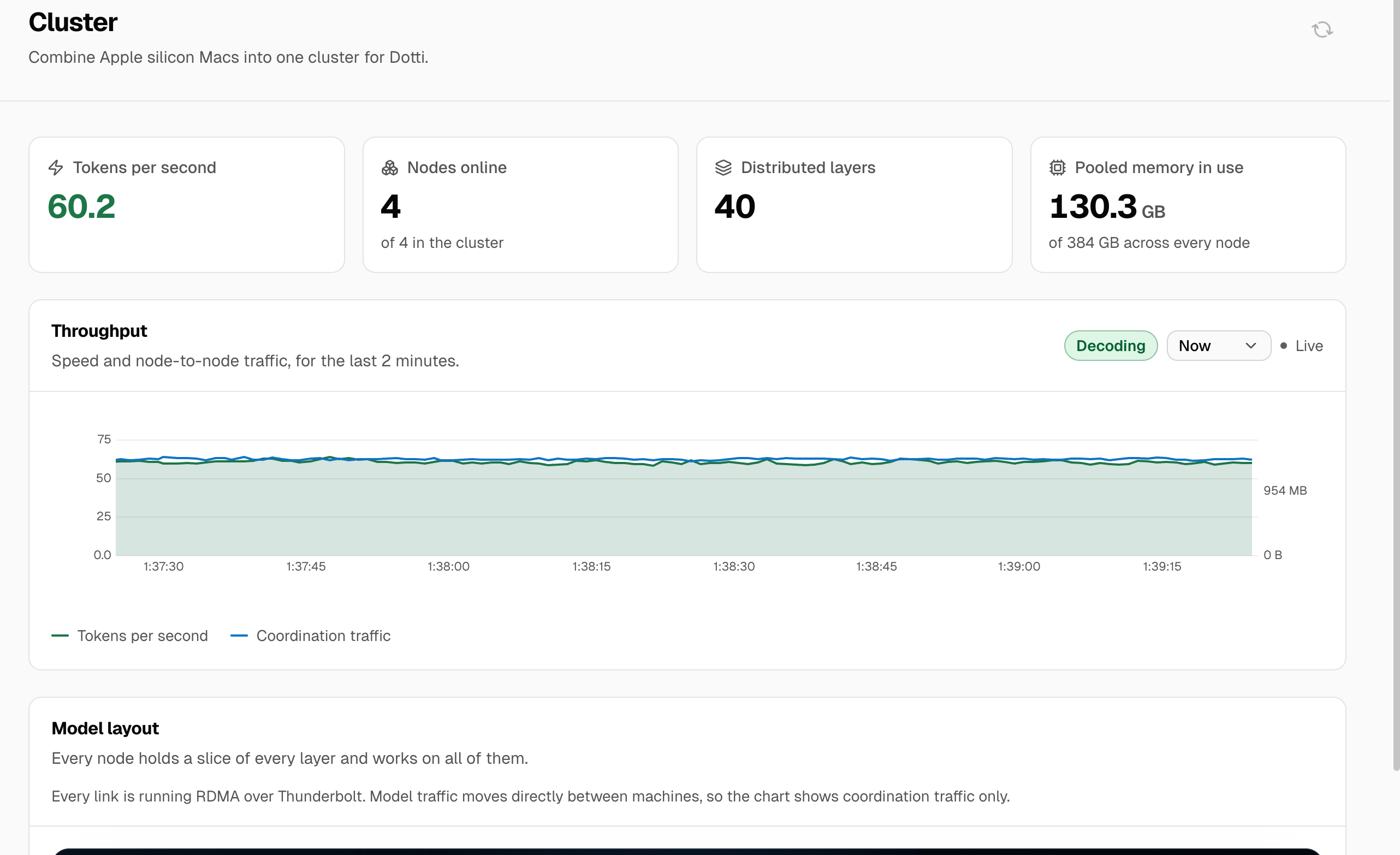
With this demo, we displayed real-time activity from the Mac Studios and demonstrated how Nexus can coordinate local AI resources in a way that is easier to observe, manage, and scale.
For enterprise and team environments, this opens up important possibilities. Instead of treating local machines as isolated AI endpoints, Nexus helps teams think about local compute as a coordinated resource. This is especially valuable when organizations want to experiment with local models, support multiple users, or distribute workloads across available hardware.
The demo also highlighted cluster mode and smart bouncer mode, showing how Msty Nexus can help route activity across nodes. The physical setup of multiple Mac Studios helped make the idea tangible. Local AI does not have to mean one machine sitting alone under a desk but how multiple machines can become part of a more capable, connected AI environment.
Smart Routing: The Right Model for the Job
Another important theme demoed at Ai4 was smart routing.
Not every AI request needs the most expensive or most powerful model available. A simple question like checking the time or weather does not need to be routed to a premium model. More complex reasoning, writing, coding, or analysis tasks may justify a stronger model. The challenge is that most end users do not want to manually choose between models every time they ask a question.
That is where smart routing becomes valuable.
With smart routes, you can configure how different requests should be handled, allowing AI tasks to be dynamically routed to the most appropriate model. This can mean using a local model for privacy-sensitive or lightweight work, a cost-effective model for routine tasks, or a more advanced hosted model when the task requires it.
This is a practical approach to AI adoption because it addresses three real concerns at once:
- Cost: avoid using expensive models for simple tasks
- Privacy: keep sensitive work local when needed
- Usability: let users interact with AI without constantly switching models
This results in a more flexible AI experience where the system can make better routing decisions behind the scenes while you don’t have to worry about switching models in the front-end.
Why Local AI Resonated at Ai4
Local AI is not only about technical preference but also becomes a way to trust AI, since your data stays local to your internal environment.
If a school is working with student information, a medical or dental practice is handling patient data, or a company is analyzing confidential internal material, the ability to keep sensitive data close matters. In some environments, teams may even want an air-gapped setup where AI can operate without internet access.
That is the kind of conversation Msty brought to Ai4 that was otherwise mostly lacking.
Our approach is balanced. Give users and organizations control over where their data goes, which models they use, and how AI tasks are handled. Local models, hosted models, and internal knowledge sources can each have a place, but the organization should be the one making that decision.
Keeping AI Yours
A core message behind our Msty products is ownership and control.
We emphasizes that user data should remain user data. The tools are designed around giving individuals and organizations confidence in how they work with AI, especially when sensitive information is involved.
That message is increasingly important as AI becomes more embedded in daily work. Organizations are no longer just experimenting with generic prompts and are beginning to connect AI to real workflows, real documents, real customer interactions, and real operational knowledge. As that happens, control over data, infrastructure, routing, and model choice becomes more important.
Msty Stack and Msty Nexus are built for that next stage.
Ai4 2026 Was a Glimpse of What Is Next
At Ai4 2026, we showcased a practical vision for where AI is going. Not just bigger and more capable models, but better systems for using models intelligently.
Msty Stack helps teams bring their knowledge into AI workflows. Msty Nexus helps teams coordinate local AI infrastructure, cluster machines, route requests, and make better use of available compute. Together, they point toward a more controlled, flexible, and organization-ready way to work with AI.
Watch Adam’s journey to Ai4 2026 for a behind-the-scenes look at the road to the event and the Msty showcase in action.