
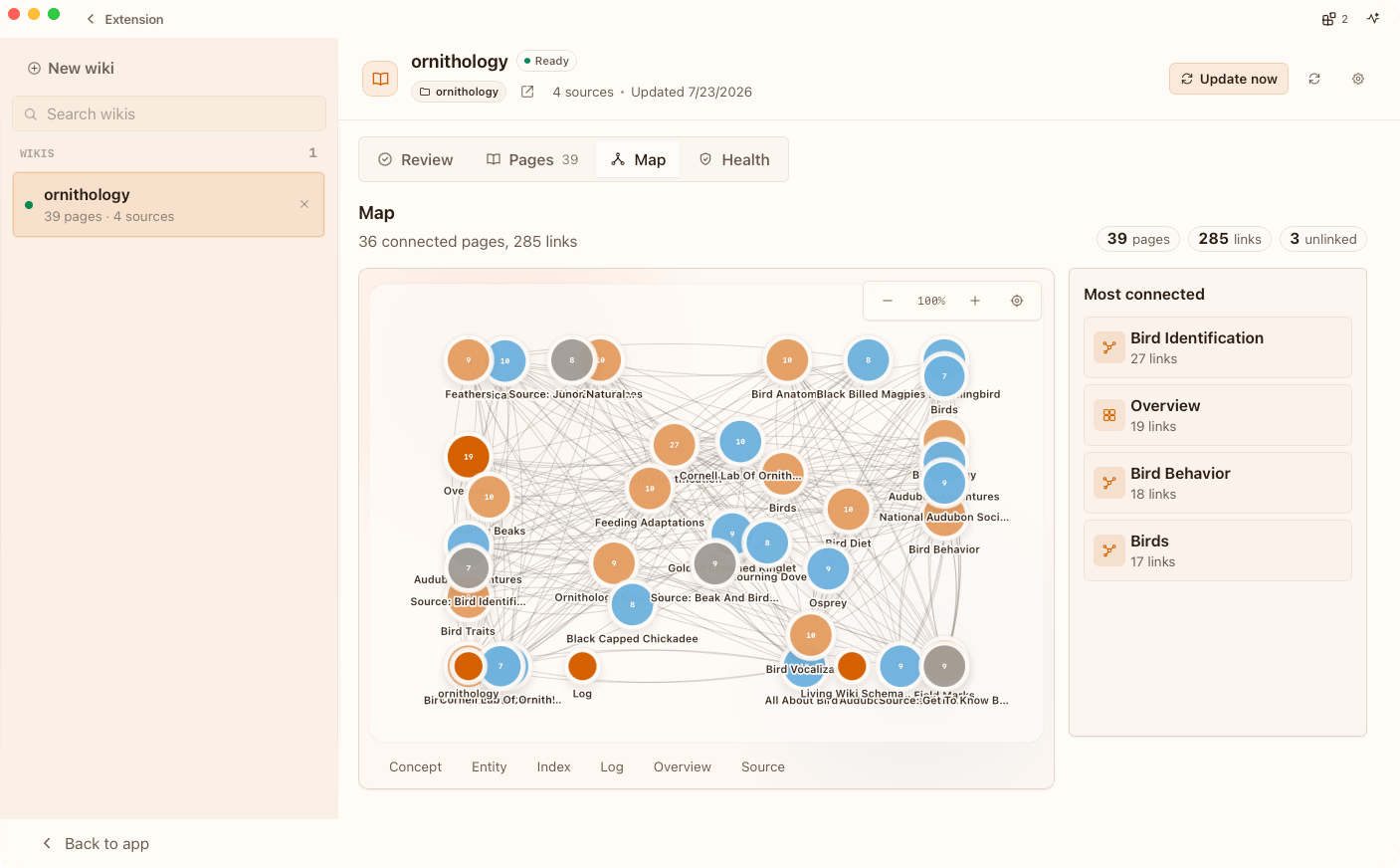
Most teams already have the raw material for a useful knowledge base: notes, PDFs, research, decisions, meeting summaries, saved chats, and project docs. The problem is that this material rarely stays organized. It piles up in folders, search results, document tools, and chat history until the facts are technically saved but hard to use.
A living wiki takes a different approach. Instead of treating knowledge as a pile of documents to search later, it turns source material into maintained, readable wiki pages that evolve as the source material changes.
Think of it as a durable knowledge layer where your raw files stay where they are, and Msty Go helps keep a structured Markdown wiki around them.
What Is a Living Wiki?
A living wiki is a human-readable, AI-maintained knowledge base. It starts with source files such as notes, Markdown, text files, PDFs, meeting notes, research, or saved assistant replies. A model reads through those sources, extracts the durable ideas, and proposes updates to wiki pages; such as:
- Overview pages
- Concept pages
- Entity pages
- Decision pages
- Question pages
- Source summaries
- Update logs
The key difference from a normal wiki is maintenance. Humans are not always consistent at keeping indexes, summaries, cross-links, and source references current. Models are well-suited to that kind of repetitive bookkeeping. A living wiki uses the model to draft the structure and updates, while the user keeps control over what becomes accepted knowledge.
How Is This Different from RAG?
RAG, or retrieval-augmented generation, usually works at question time. When you ask a question, the system searches a document index, pulls back chunks that seem relevant, and gives those chunks to the model to answer from.
That is useful, but it has limitations:
- It often retrieves fragments, not settled understanding.
- It repeats the same retrieval and synthesis work every time.
- It can miss context when related facts live in separate chunks.
- It can be hard to audit why a certain answer was produced.
- It does not naturally create a better knowledge base over time.
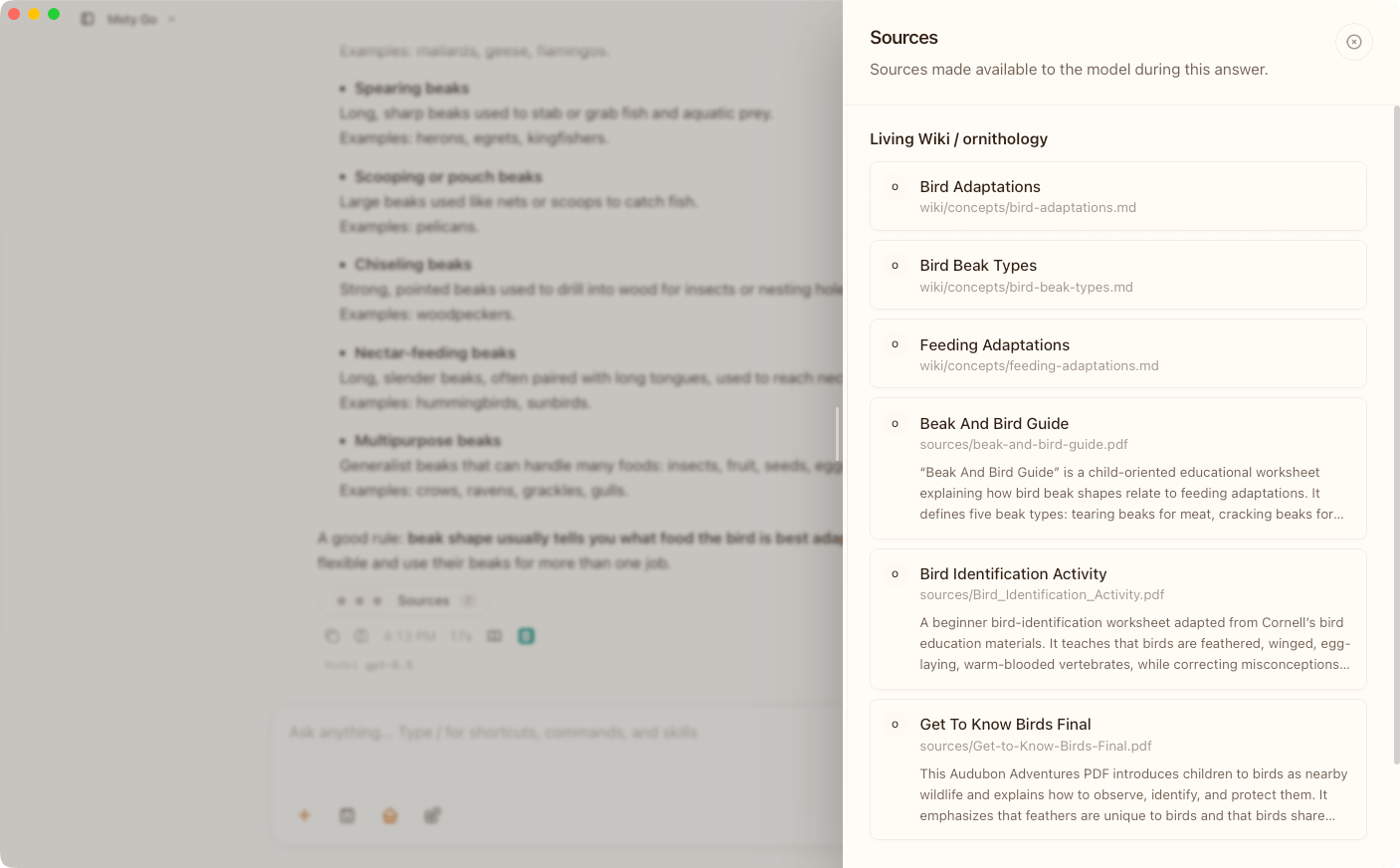
A living wiki shifts more work to ingest time. When source files change, the system reads them, summarizes them, links them to existing ideas, and proposes durable updates. Later, when you ask a question, the model can use the maintained wiki map first instead of searching raw documents from scratch.
RAG asks, “Which chunks should I retrieve right now?”
A living wiki asks, “What should our knowledge base now know?”
Living Wiki vs. RAG
| Dimension | RAG | Living Wiki |
|---|---|---|
| Main job | Retrieve relevant chunks at query time | Maintain durable knowledge over time |
| Source shape | Raw documents or chunks | Curated Markdown pages with links and summaries |
| Best for | Fast search over large raw corpora | Evolving knowledge, decisions, research, and project memory |
| Human review | Often absent or separate | Central to the workflow |
| Auditability | Depends on citations and retrieval logs | Easier because pages, sources, reviews, and logs are files |
| Freshness | Depends on the indexing pipeline | Depends on update runs and review status |
| Cost profile | Repeats synthesis at query time | Does more synthesis once, then reuses it |
| Weakness | Can return fragmented context | Requires maintenance discipline and update workflows |
Which Is Better?
Neither replaces the other.
RAG is better when you need broad lookup across a large or constantly changing corpus and do not need every retrieved fact to become curated knowledge. It is useful for search, support docs, large archives, and one-off questions.
A living wiki is better when the same knowledge will be reused, refined, reviewed, and trusted over time. It is especially strong for research, product work, internal operations, project memory, legal or policy notes, and any workflow where “what do we know now?” matters more than “what chunk matched this query?”
How Msty Go’s Living Wiki Extension Works
Msty Go’s Living Wiki extension turns a folder you choose into a maintained Markdown wiki. You stay in control of the files while Msty Go handles the reading, summarizing, linking, and review workflow.
The extension can:
- Create a wiki folder with sources, wiki, reviews, and local state.
- Read Markdown, text files, and PDFs.
- Generate source summaries and maintained wiki pages.
- Keep an index, overview, and log current.
- Propose concept, entity, decision, and question pages.
- Surface updates in a review queue before meaningful changes are applied.
- Let you accept, edit, reject, or rerun proposed changes.
- Add relevant wiki context to chat when you turn on Living Wiki.
- Save useful assistant replies as proposed wiki updates.
- Run checks for stale reviews, weak links, missing sources, duplicate titles, broken wiki links, and other maintenance issues.
The important product choice is review-first. Living Wiki will not silently rewrite your knowledge base but rather it prepares proposed changes, shows what would change, and lets you decide what becomes part of the wiki.
Why Plain Files Matter
A living wiki should not trap your knowledge inside an app. Msty’s approach keeps the wiki as Markdown files that users can inspect and edit directly.
Plain files make the system:
- Portable
- Versionable
- Reviewable
- Searchable outside the app
- Friendly to humans and agents
- Easier to back up or sync
This is also why the living wiki pattern is gaining momentum beyond Msty AI.
Google’s Open Knowledge Format
In June 2026, Google Cloud introduced Open Knowledge Format, or OKF, as an open specification for representing AI-ready knowledge as Markdown files with YAML frontmatter. OKF formalizes many of the same ideas behind living wikis: plain files, human readability, agent readability, provenance, links, indexes, logs, and portability.
In July 2026, Google Cloud followed with OKF v0.2, expanding the format around trust signals, provenance, lifecycle status, and freshness. The OKF specification remains intentionally file-based and minimally opinionated.
Msty’s Living Wiki extension does not currently claim OKF compliance as a formal standard. It already shares the broad philosophy of using markdown files, frontmatter, source references, indexes, logs, and reviewable updates. However, OKF does have specific conventions for fields like provenance, trust, lifecycle status, standard Markdown links, and concept structure.
This makes OKF a strong candidate for a future Living Wiki version.
The Bigger Shift
RAG helped models find information. Living wikis help teams preserve understanding.
That distinction helps because you not only need better search but also you need a knowledge base that improves as the work changes.
That is the promise of Living Wiki in Msty Go where you can keep your files yours, let AI handle the maintenance work, and keep humans in control of what becomes trusted knowledge.
Explore the Msty Go Extensions catalog to see how extensions can shape Go around the way you work.